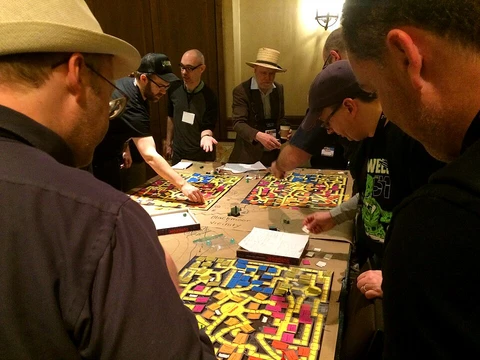
The Warlock of Firetop Mountain (board game)
A deduction-based dungeon board game from 1986.

The Warlock of Firetop Mountain is a board game published by Games Workshop in 1986, designed by Steve Jackson (the British game designer, not the American one of the same name). It is based on the Fighting Fantasy gamebook of the same name, which Jackson co-created with Ian Livingstone in 1982. The game accommodates 2 to 6 players and typically lasts about two hours.
- publisher
- Games Workshop
- year_published
- 1986
- players
- 2-6
- typical_game_length
- two hours
- designer
- Steve Jackson (British)
- based_on
- Fighting Fantasy gamebook The Warlock of Firetop Mountain
- box_illustrator
- Peter Andrew Jones
- interior_illustrator
- Dave Andrews
Lore & Background
The game involves players roaming a labyrinth, fighting creatures, and finding treasures. Each player has three basic scores—SKILL, STAMINA, and LUCK—mirroring the system from the original gamebook. To win, players must travel across the board to the dungeon's end, open the warlock Zagor's treasure chest, and deduce the correct combination of three keys, which they obtain by finding or stealing them. The key deduction system resembles that of Cluedo, with players asking others whether they hold key cards showing particular numbers and secretly noting the answers.
Reader's Guide
The Warlock of Firetop Mountain board game is significant as a licensed adaptation of a landmark Fighting Fantasy gamebook, bringing the solo adventure format to a multiplayer board game. Its combination of dungeon exploration with a deduction mechanic, likened to Cluedo, was noted by contemporary reviewers as adding depth uncommon in dungeon-bashing board games. The game's production quality was praised, though the box incorrectly stated 77 encounter pieces when only 66 were included. Retrospective reviews highlight it as a product of its era, with artwork and miniatures that capture 1980s style, but note it has not received the same modern reprints as similar titles like Talisman or Dungeonquest. Its legacy lies in representing a specific moment in board game history, valued more as a collector's piece and historical artifact than as a competitive modern game.
Did You Know?
- The box states 77 encounter pieces, but the actual count is 66.
- The game uses a key deduction system similar to Cluedo.
- The box was illustrated by Peter Andrew Jones and interior illustrations by Dave Andrews.
- A typical game lasts two hours.
More in Adventure board games 1-22
Spotted an error? Know more?
This is a living reference — every entry is fact-audited, and reader corrections feed straight into our audit queue. Suggest an edit · See this site's audit record