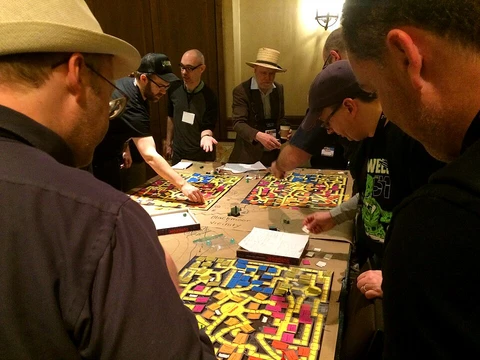
Adventure board game
Board games featuring unique characters that improve through play.

An adventure board game is a board game in which a player plays as a unique individual character that improves through gameplay, commonly reflected in increasing character attributes, new abilities, or equipment. The genre originated in the 1970s, drawing from early role-playing games, and saw its key subgenres codified in the 1980s.
- field
- Board game genre
- known_for
- Character progression, integration of RPG mechanics
- first_game
- Dungeon! (1975)
- key_subgenres
- Competitive fantasy, cooperative investigative, cooperative fantasy
Lore & Background
The adventure board game genre emerged from the early role-playing game community of the 1970s. Dave Arneson introduced his role-playing game Blackmoor to a group that included Gary Gygax, who co-created Dungeons & Dragons (1974). Another member, Dave Megarry, translated that experience into Dungeon! (1975), recognized as the first adventure board game. The term 'adventure gaming' originally referred to tabletop role-playing games before becoming associated with board games.
In the 1980s, the genre's key subgenres were codified by three major releases: competitive fantasy adventure games (Talisman, 1983), cooperative investigative adventure games (Arkham Horror, 1987), and competitive fantasy adventure games with one player as the Game Master (HeroQuest, 1989). The 1990s saw a sharp decline in popularity due to the collectible card game boom and bust.
The 2000s brought a revival led by Fantasy Flight Games with Runebound (2004), the second edition of Arkham Horror (2005), and Descent: Journeys in the Dark (2006). Other companies contributed, such as Atlas Games' card-based Dungeoneer (2003) and Pegasus Spiele's Return of the Heroes (2003), which was an early example employing eurogame mechanics. In the 2010s, Wizards of the Coast published cooperative fantasy adventure games based on the fourth edition of Dungeons & Dragons, including Castle Ravenloft (2010), Wrath of Ashardalon (2011), and The Legend of Drizzt (2011).
Reader's Guide
Adventure board games represent a significant crossover between role-playing games and traditional board games, allowing players to experience character growth and narrative progression within a structured format. The genre's development mirrors the evolution of tabletop gaming, from its roots in the 1970s role-playing scene through the commercial boom of the 1980s and the subsequent decline in the 1990s. The revival in the 2000s, particularly by Fantasy Flight Games, demonstrated the genre's enduring appeal and adaptability, incorporating eurogame mechanics to attract a broader audience. The return to its roots in the 2010s with official Dungeons & Dragons-themed games further cemented its place in gaming culture. Adventure board games have influenced game design by blending RPG elements like experience points and character creation with board game mechanics, creating a hybrid genre that continues to evolve.
Did You Know?
- The first adventure board game was Dungeon! (1975), created by Dave Megarry.
- The term 'adventure gaming' originally referred to tabletop role-playing games, not board games.
- HeroQuest (1989) is primarily a competitive game with one player as the Game Master/Zargon versus the others.
- Return of the Heroes (2003) was one of the earliest adventure board games to employ eurogame mechanics.
The Board Game as Narrative Engine
The Zathura board game functions as the central mechanism driving every beat of the story. Discovered by six-year-old Danny in the family basement, this science fiction-themed game immediately reshapes reality: a single card triggers a meteor shower that launches the house into outer space. From that point forward, the rules of the game dictate the siblings' survival. Each turn introduces escalating threats—a malfunctioning robot, a dangerously close pass by a star, and an assault by reptilian aliens called Zorgons. The game also enforces its own moral code; when Walter moves Danny's piece without permission, the board treats it as cheating and ejects him into the void. A wish-card mechanic adds emotional weight, as the boys must decide what to desire under pressure. In the film's climax, Zathura is revealed to be a black hole that swallows the Zorgon fleet and the house itself, depositing the family back in their living room as if nothing happened. The game is never explained beyond its rules—it simply is, and its logic governs everything.
A Commitment to Tangible Spectacle
Director Jon Favreau made a deliberate choice to build Zathura's world with physical sets and miniature models rather than relying on digital imagery. He cited the Star Wars trilogy as a touchstone for his approach, noting that constructing real spaceships, a working robot prop, and Stan Winston–crafted Zorgon creatures gave the young cast tangible things to react against. Dax Shepard has stated he would have passed on the project had the effects been purely computer-generated, and Kristen Stewart recalled that the on-set stunts—ripping walls apart, actual fire—felt genuine, with the sole green-screen moment being the black hole sequence. The film was shot across Los Angeles and Culver City, with the house exterior captured on Oaklawn Avenue in South Pasadena. While a handful of Zorgon ship shots did employ digital creation, the overwhelming production philosophy favored hands-on craftsmanship. Favreau also acknowledged drawing narrative and visual inspiration from Star Wars, Indiana Jones, Battle Beyond the Stars, and Superman, blending those influences into a family-friendly space odyssey.
Two Brothers, One Game, and the Weight of a Wish
At the heart of Zathura is the friction between ten-year-old Walter and his six-year-old brother Danny, a rivalry that the board game both exposes and ultimately resolves. Their conflict escalates when Walter, convinced Danny has moved his piece, forcibly resets it and attempts to steal a turn—an act the game punishes by hurling Walter into space. The emotional turning point arrives through the wish-card sequence. The astronaut who rescues Walter reveals his own tragic backstory: as a child, he and his brother played Zathura, and after a fight he wished his sibling out of existence, leaving him stranded forever because the game demands two players. Hearing this, the brothers finally reconcile. Walter then uses his wish not to eliminate Danny but to summon a signed football, and later to restore the astronaut's lost brother—who turns out to be Danny himself, making the astronaut an older Walter from a parallel timeline. The film closes with the siblings bonded, vowing silence about their cosmic ordeal.
Franchise Roots and a Modest Box-Office Run
Zathura: A Space Adventure occupies a specific niche in the Jumanji franchise. It is a standalone spin-off of the 1995 Jumanji film and the second entry in that series, adapted from Chris Van Allsburg's 2002 children's book of the same name. Van Allsburg had previously authored the 1981 Jumanji novel, making the shared authorship a deliberate creative thread. The screenplay was penned by David Koepp and John Kamps, with Favreau at the helm. The cast pairs Josh Hutcherson and Jonah Bobo as the brothers, with Kristen Stewart as their teenage sister Lisa, Tim Robbins as the absent-then-returning father, and Dax Shepard as the enigmatic astronaut. Frank Oz provided the robot's voice while John Alexander performed the physical role. Sony Pictures Releasing brought the film to U.S. theaters on November 11, 2005. Critics responded favorably, and the picture collected $65.1 million globally against a $65 million production budget—a near-even return that underscored its modest but solid commercial performance.
Frequently Asked Questions
What is an adventure board game?
It is a board game genre in which each player controls a distinct character that grows stronger over the course of play by gaining new stats, abilities, or equipment. Rather than treating all pieces as interchangeable tokens, the genre lets your avatar's identity and power level evolve turn by turn.
When did the adventure board game genre originate and what was the first title?
The genre emerged in the 1970s, drawing heavily on the early tabletop role-playing game movement of that decade. Dungeon! (1975) is widely recognized as the first published game in the category.
What are the main subgenres of adventure board games?
Three key subgenres were codified during the 1980s: competitive fantasy, cooperative investigative, and cooperative fantasy. They differ primarily in whether players compete head-to-head or team up toward a shared narrative goal.
How do adventure board games differ from standard strategy board games?
The defining feature is persistent, individual character progression built around RPG-style mechanics such as attribute growth and ability unlocks. This makes each player's experience unique and story-driven rather than purely tactical with identical pieces.
Why is the adventure board game genre considered important in board game history?
It bridged the gap between solo role-playing narratives and group table-top play, introducing lasting character development to a medium that had previously relied on abstract, interchangeable pieces. Its influence on modern design is still visible in how many contemporary titles let players build and customize unique characters.
More in Adventure board games 1-22
Spotted an error? Know more?
This is a living reference — every entry is fact-audited, and reader corrections feed straight into our audit queue. Suggest an edit · See this site's audit record