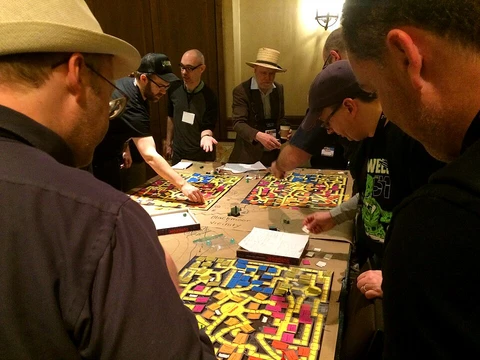
Diamant (board game)
A push-your-luck card game of diamond mining.

Didier Descouens · Public domain
Diamant is a multiplayer card game designed by Alan R. Moon and Bruno Faidutti, published in 2005 in Germany by Schmidt Spiele. It is a push-your-luck game in which players act as adventurers searching for treasure in a diamond mine while avoiding hazards. The game was recommended for the Spiel des Jahres award in 2005 and has been released in an English-language edition under the name Incan Gold.
- designers
- Alan R. Moon and Bruno Faidutti
- publisher
- Schmidt Spiele (2005)
- illustrators
- Jörg Asselborn, Christof Tisch, Claus Stephan
- genre
- Multiplayer card game
- awards
- Spiel des Jahres 2005 Recommended; International Gamers Awards 2005 Nominee; Japan Boardgame Prize 2005 Best Foreign Game for Beginners; 2006 BoardGameGeek Golden Geek Best Light/Party Game
Lore & Background
According to Bruno Faidutti's website, Diamant is Faidutti's second collaboration with Alan R. Moon. Faidutti said that they both held Can't Stop by Sid Sackson 'in great esteem' and wanted to design their own game where players would choose between keeping what they have or risking losing it all. Faidutti said he suggested a kind of 'common pool Can't Stop' where all players were in the same situation but could make different decisions. The theme was described as 'somewhere between Indiana Jones and Alan Quatermain'.
The first prototype used an Incan or Mayan temple as the setting. Danger cards were initially frightening noises but were changed by the publisher. An attempt to add action cards was not successful in playtesting. Friedemann Friese suggested that the card 'that triggered the bust' be removed and that only one voting token was necessary. Jürgen Valentiner Brandt of Schmidt Spiele made the first firm proposal, and a contract was signed in September 2004. The game was published for the Nürnberg fair in February 2005. Faidutti felt the original title 'The Temple of Doom' was much stronger, but the publishers changed it to Diamant.
Alan R. Moon talked with various American publishers, and the U.S. edition was published in late 2006 by Sunriver Games under the name Incan Gold. The publishers wanted to rename it 'The Temple of Doom' but went with Incan Gold because of legal issues. Faidutti noted that Incan Gold had some changes: the rules stayed the same, but Incan Gold does not have cardboard chests or wooden pawns, and artifact cards were added.
Reader's Guide
Diamant is significant as a well-regarded push-your-luck game that won a Spiel des Jahres recommendation in 2005, a mark of quality in the board game industry. Its design, inspired by Sid Sackson's Can't Stop, refined the mechanic of collective risk-taking where all players share the same pool of treasure but individually decide when to leave. The game's success led to an English-language edition, Incan Gold, which introduced artifact cards and a temple theme while keeping the core rules identical. The game's legacy includes nominations for the International Gamers Awards and the Japan Boardgame Prize, as well as a Golden Geek award for Best Light/Party Game. Its straightforward yet tense gameplay has made it a staple for casual and family gaming, demonstrating how a simple risk-reward decision can create engaging social dynamics. The development history, including the rejected title 'The Temple of Doom' and the publisher's changes to danger cards, illustrates the iterative process of game design and the influence of publisher feedback.
Did You Know?
- Diamant was originally titled 'The Temple of Doom' by the designers, but the publisher changed it to Diamant.
- The English-language edition, Incan Gold, was renamed due to legal issues with the title 'The Temple of Doom'.
- Friedemann Friese suggested removing the card that triggered the bust and using only one voting token.
- The first prototype of the game used an Incan or Mayan temple as the setting.
Gallery



Frequently Asked Questions
What is Diamant?
Diamant is a multiplayer push-your-luck card game in which players role-play as treasure hunters exploring a diamond mine. It was designed by Alan R. Moon and Bruno Faidutti and published by Schmidt Spiele in Germany in 2005.
Who designed Diamant and who illustrated it?
The game was created by board game designers Alan R. Moon and Bruno Faidutti. The artwork was a collaboration among Jörg Asselborn, Christof Tisch, and Claus Stephan, with Schmidt Spiele handling publication in 2005.
How does Diamant gameplay work?
Each player takes turns sending an adventurer deeper into the mine to grab diamonds while hazards accumulate, creating a classic push-your-luck tension. You can keep going for bigger hauls or bail out to bank your treasure, but if the mine collapses before you run, you lose everything you collected that round.
What awards and nominations has Diamant received?
Diamant was a recommended title for the 2005 Spiel des Jahres and earned a nomination at the 2005 International Gamers Awards. It also won the Japan Boardgame Prize for Best Foreign Game for Beginners in 2005 and the BoardGameGeek Golden Geek for Best Light/Party Game in 2006.
What is Diamant called in English?
The English-language release of the game was published under the title Incan Gold. The core diamond-mining push-your-luck mechanics stay the same, though the English edition rethemed the setting around Incan treasure.
More in Adventure board games 1-22
Spotted an error? Know more?
This is a living reference — every entry is fact-audited, and reader corrections feed straight into our audit queue. Suggest an edit · See this site's audit record