Dungeonquest
A fantasy board game of random dungeons and deadly treasure.

Dungeonquest, also referred to as Dungeon Quest, is a fantasy adventure board game that first appeared in Sweden in 1985 under the title Drakborgen, published by Alga AB. An English version followed in 1987 from Games Workshop.
The game is designed for one to four players. The goal is to enter the ruins of Dragonfire Castle at dawn, when the guardian dragon is asleep, navigate a randomly generated labyrinth to reach the dragon's hoard at the castle's center, and then escape before sunset. Any character still inside the castle at sunset is killed by the dragon. The winner is the player who exits with the most treasure.
The Games Workshop edition includes a 20-page rulebook, a six-piece gameboard, 115 room tiles, various counters and tokens, 174 playing cards, dice, and four plastic miniatures.
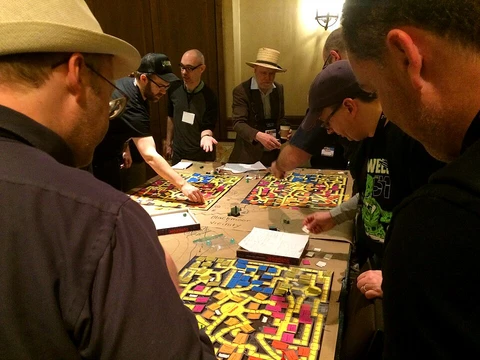
At the start of play, the board is blank except for the dragon's hoard in the center. Room tiles are placed facedown nearby, and the time track is set to "Dawn." On a turn, a player picks a random room tile and places it on an empty grid space. Tiles come in many configurations—rooms with multiple doorways, corners, hallways, dead ends, bottomless pits, rotating rooms, and more. When a character enters a room, a card is drawn to determine the challenge, which may include monsters, chasms, crypts, traps, or secret doors.
The game's concept began with Jakob Bonds, who created Drakborgen (Dragon Fortress) while in high school in Sweden. In the early 1980s, he submitted it to Alga AB. Dan Glimne, an Alga employee since 1980, was working on a similar fantasy game called Trollkarlens borg (The Wizard's Castle). Both felt a "family fantasy" board game was needed, so they merged their ideas and developed the project together. Drakborgen was published in 1985 with illustrations by Anders Jeppson.
Games Workshop's 1987 English version, Dungeonquest, included four plastic miniatures from Citadel Miniatures. In Sweden, Alga released an expansion, Drakborgen II, in 1987. Games Workshop split this into two supplements: Heroes for Dungeonquest (1987), adding twelve new heroes with special abilities, extra cards and tokens, and twelve metal Citadel miniatures; and Dungeonquest Catacombs (1988), adding 20 room tiles, 28 new cards for monsters, encounters, and objects, and the ability for players to travel beneath the main board (though no separate catacombs board was included). Fan
- original publisher
- Alga AB (Sweden)
- English publisher
- Games Workshop
- year of original publication
- 1985
- designers
- Jakob Bonds and Dan Glimne
- players
- 1–4
- genre
- Fantasy adventure board game
Lore & Background
Jakob Bonds created the concept of Drakborgen (Dragon Fortress) while in high school in Sweden. In the early 1980s, he submitted the game to Alga AB for consideration. Dan Glimne, who had been working at Alga since 1980, was also working on a fantasy board game with a similar theme titled Trollkarlens borg (The Wizard's Castle). Both Bonds and Glimne felt a 'family fantasy' board game was needed, and they agreed to merge their two game ideas and jointly develop the new project. The result was Drakborgen, published in 1985 with illustrations by Anders Jeppson.
Games Workshop published an English-language version titled Dungeonquest in 1987 that included four plastic miniatures produced by Citadel Miniatures. In Sweden, Alga AB released an expansion called Drakborgen II in 1987. Games Workshop also published this expansion, but divided it into two supplements: Heroes for Dungeonquest (1987) and Dungeonquest Catacombs (1988). Fantasy Flight Games introduced a new version of the English-language game at Gen Con in 2010. The Swedish edition is still being published by Alga as Drakborgen: Legenden.
Reader's Guide
Dungeonquest is significant as an early example of a board game that generates its dungeon map randomly during play, using room tiles placed facedown and drawn at random. The objective—enter the ruins of Dragonfire Castle at dawn, navigate a labyrinth to the dragon's hoard, and exit before sunset—creates a tense, time-limited experience. The game's high lethality was noted by reviewers: Ken Rolston in Dragon (Issue 168) commented that 'hard-nosed adventurers aiming for a big haul from the dragon's hoard will die like flies,' while John Woods in The Games Machine found that random chance dominated over player skill, leading to limited replay appeal. Despite this, the game has endured through multiple editions and expansions, including a 2010 version by Fantasy Flight Games and continued publication in Sweden. Its legacy lies in its influence on dungeon-crawl board games and its emphasis on emergent storytelling through random tile placement.
Did You Know?
- The game was originally created by Jakob Bonds while he was in high school in Sweden.
- The English version published by Games Workshop included four plastic miniatures produced by Citadel Miniatures.
- The game ends at sunset; any characters still in the castle at that point are automatically killed by the dragon.
- The Swedish edition is still being published as Drakborgen: Legenden.
Gallery
Frequently Asked Questions
What is Dungeonquest?
Dungeonquest is a one-to-four-player fantasy board game where you sneak into Dragonfire Castle at dawn, grab gold from a sleeping dragon's hoard, and race back out before it wakes. The labyrinth layout is generated randomly each session, so no two runs look alike.
Who designed Dungeonquest?
The game was created by Swedish designers Jakob Bonds and Dan Glimne. It debuted in 1985 under the Swedish title Drakborgen, published by Alga AB.
What happens if a player is still inside the castle at sunset?
The guardian dragon kills any character that hasn't escaped by the time the sun goes down. This sunset deadline is the core tension mechanic that forces players to balance greed for extra treasure against the risk of being trapped.
How does the random dungeon generation work in Dungeonquest?
Each playthrough assembles a fresh labyrinth of corridors and rooms, meaning the path to the central hoard and the routes back out change every time. Players can never memorize a safe route and must navigate on the fly.
Who published the English-language version of Dungeonquest?
Games Workshop released the English edition in 1987, two years after the original Swedish launch. The 1985 Drakborgen edition had been put out by Alga AB in Sweden.
More in Adventure board games 1-22
Spotted an error? Know more?
This is a living reference — every entry is fact-audited, and reader corrections feed straight into our audit queue. Suggest an edit · See this site's audit record