Magic Realm
Complex fantasy board game with cult following, out of print since 1998.

Creator:Various artists · Public domain
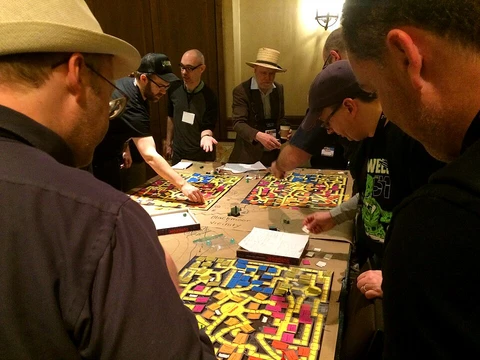
Magic Realm is a fantasy adventure board game created by Richard Hamblen and released by Avalon Hill in 1979. It is more intricate than most wargames and shares some traits with role-playing games. The game supports solo play or up to six players (or occasionally up to eight with expansions or unofficial variants), and a session can last four hours or more. The board is made from large, double-sided hexagonal tiles that fit together in many configurations, creating a geomorphic map.
A second edition of the rules, which changed the rulebook format and tweaked some gameplay elements, came out in 1986 and was included in copies sold after that date. The game has been out of print since before 1998, when Avalon Hill was acquired by Hasbro (the brand continued, but Magic Realm was not reprinted). Because of its uniqueness and difficulty, Magic Realm has gained a cult following. Some fans have written an unofficial "Third Edition" of the rules to clear up confusing parts, and several websites still promote the game.
In gameplay, each player controls one or more of sixteen characters, each with distinct abilities, strengths, weaknesses, and relationships with the native groups and visitors that appear on the board. After choosing characters, players set personal victory conditions by distributing 2 to 5 points across five categories: Great Treasures, Spells, Fame, Notoriety, and Gold. The point allocation usually fits the character type. Players then pursue these goals through fighting monsters, trading, searching for treasure and items, and interacting with other characters and beings in the Realm. The first player to meet their personal victory conditions wins. For example, a Swordsman might put 2 points in Great Treasures, 1 in Fame, and 2 in Gold, needing two great treasures, ten fame, and sixty gold pieces to win. Since the Swordsman has no magic, they would ignore spells. A Wizard, on the other hand, might reduce gold and great treasures to focus on spells. Winning is tough, and characters often die from monsters, hostile natives, or treacherous players.
The game introduced several groundbreaking features for its time. Treasure sites, monsters, treasures, and spell cards are randomly distributed. The board is built by players from hexagonal tiles that can be arranged in millions of ways, as long as paths stay connected. Characters with magical skills can e
- Players
- 1 to 6 (up to 8 with expansions/unofficial variants)
- Out of Print Since
- Late 1990s
Lore & Background
Magic Realm was published by Avalon Hill in 1979, designed by Richard Hamblen. The game features a geomorphic mapboard of double-sided hexagonal tiles that can be arranged in millions of ways. Players choose from sixteen characters, each with unique abilities, and set personal victory conditions across categories like Great Treasures, Spells, Fame, Notoriety, and Gold. The game can be played solitaire or with up to six players (or occasionally up to eight with expansions or unofficial variants), with sessions lasting four hours or more.
A second edition of the rules was published in 1986, changing the rulebook format and some gameplay. The game has been out of print since the late 1990s; Avalon Hill was acquired by Hasbro in 1998 and continued as a brand, but Magic Realm was not reprinted. Due to its complexity and uniqueness, fans have written an unofficial 'Third Edition' of the rules to clarify ambiguities, and many websites promote the game.
Gameplay involves fighting monsters, trading, questing, and
Reader's Guide
Magic Realm's significance lies in its groundbreaking design for its time, including random distribution of treasure sites, monsters, treasures, and spell cards, and a novel board built from hexagonal tiles. Its complexity and depth have given it a cult status, with dedicated fans maintaining unofficial rule clarifications and websites. The game's influence is seen in its unique victory condition system, where players set personal goals, and its geomorphic board that ensures high replayability.
Reception was mixed: some reviewers praised the components and innovative ideas, while others criticized the murky rules and steep learning curve. Nicholas Barker in Perfidious Albion called it 'probably the best boardgame/wargame treatment of a fantasy subject available' but noted it was 'damned hard to learn.' Eric Goldberg in Ares Magazine rated it 4 out of 9, saying 'there could have been a great game in Magic Realm, but it was aborted early.' Colin Reynolds in White Dwarf gave it 7 out of 10, stating 'as a game, it excels.'
Legacy includes the Java application Realm Speak by Robin Warren, which simulates the game on computers, eliminating setup time and enforcing all rules. The game remains a touchstone for complex fantasy board games, with its cult following ensuring continued interest through fan resources and online play.
Did You Know?
- Magic Realm can be played solitaire or with up to 16 players.
- The game board is constructed from large double-sided hexagonal tiles that can be arranged in millions of ways.
- A second edition of the rules was published in 1986, changing the rulebook format and some gameplay.
- Robin Warren wrote a Java application called Realm Speak that simulates the game on computers.
Gallery



Frequently Asked Questions
What is Magic Realm?
Magic Realm is a fantasy adventure board game designed by Richard Hamblen and published by Avalon Hill in 1979. It blends elements of wargaming with role-playing mechanics, making it far more intricate than a typical strategy title.
How many players can Magic Realm support?
The standard rules accommodate one to six players, though expansions and unofficial variants can stretch that to eight. Solo play is also fully supported, which is notable for a game of this complexity.
How long does a session of Magic Realm take?
A single game typically runs four hours or longer, which is a significant time commitment even by board-game standards. Players should plan for a full evening or longer to see a game through to resolution.
What is the geomorphic board in Magic Realm?
Instead of a fixed map, the playing surface is assembled from large double-sided hexagonal tiles that can be arranged in countless configurations. This means no two games feature the same terrain layout, adding a fresh spatial challenge every session.
Is Magic Realm still available for purchase?
The title has been out of print since the late 1990s, so new copies are no longer produced by Avalon Hill. Fans looking to play it today generally rely on secondhand copies or community-shared rule resources.
More in Adventure board games 1-22
Spotted an error? Know more?
This is a living reference — every entry is fact-audited, and reader corrections feed straight into our audit queue. Suggest an edit · See this site's audit record