Android (board game)
A dystopian murder investigation board game with multiple victory paths.

Syced · CC0
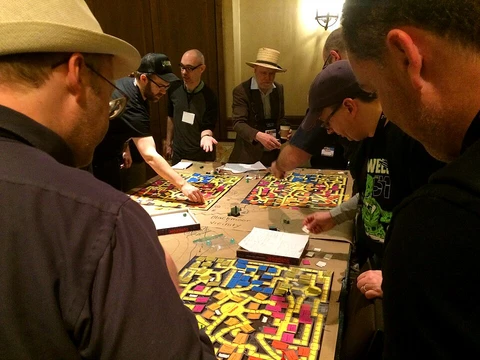
Android is an adventure board game designed by Kevin Wilson and Dan Clark, published in 2008 by Fantasy Flight Games. Set in a dystopian future where the Moon is colonized and androids and clones are real, players take on the roles of murder investigators. The game is notable for its complex blend of murder investigation, conspiracy solving, and personal character plots, offering multiple victory paths.
- Designers
- Kevin Wilson and Dan Clark
- Publisher
- Fantasy Flight Games
- Year Published
- 2008
- Genre
- Adventure board game
- Number of Players
- Not specified in article
- Playing Time
- Not specified in article
Lore & Background
Android is set in a dystopian future featuring the colonized Moon and the existence of androids and clones. The game takes place in the fictional cities of New Angeles (a future version of Los Angeles placed on the equator to accommodate a space elevator) and Heinlein, a colony on the Moon. Players act as murder investigators trying to prove their suspect is guilty, while also uncovering a conspiracy and resolving their investigator's personal issues.
Reader's Guide
Android is significant for its intricate design that combines multiple gameplay elements—murder investigation, conspiracy puzzle, and personal character plots—into a single competitive experience. The game uses a unique evidence system where tiles with numbers from -4 to +5 determine suspect guilt or innocence, and a conspiracy puzzle that rewards players with Victory Points for linking tiles. The inclusion of a Twilight Track, where Light and Dark Cards shift a character's alignment, adds a psychological layer. The game's legacy lies in its ambitious scope and thematic depth, influencing later narrative-driven board games. Its design by Kevin Wilson and Dan Clark, published by Fantasy Flight Games, has made it a cult classic among enthusiasts of complex, story-rich games.
Did You Know?
- The gameboard includes a space elevator called The Beanstalk, which connects Earth and the Moon through five areas.
- Each player has a unique investigator with personal plots, such as Floyd 2X3A7C, a Bioroid who can shed his programming directives.
- Evidence tiles include Surprise Witnesses (blue faces, value -5) and Perjury tiles (red faces, value +5) that cancel Alibis or Surprise Witnesses.
- Players can become 'obsessed' with a suspect if their guilty and innocent hunch cards name the same suspect, earning bonus Victory Points.
From Boys' School Prefect to Fantasy Epic
Robert Harris did not set out to create a landmark board game. He designed the prototype purely for the amusement of himself and his friends, and its original premise was far from the high-fantasy world we know today. The goal was simply to become the prefect of a boys' school. Recognizing the potential in the mechanics, Harris re-themed the game into a fantasy setting and christened it Talisman. He then signed a royalty-based publishing deal with Games Workshop, and the finished product debuted at Games Day in 1983. The game went through three revisions under the original publisher's banner, and after the third edition was released, Games Workshop purchased Harris's remaining stake in the title. What began as a lighthearted schoolyard scenario thus became one of the most recognizable fantasy board games of its era, selling more than 800,000 copies by the year 2000.
The Road to the Crown of Command
Talisman is built around one elegant objective: reach the Crown of Command at the board's centre. The playing surface is divided into three regions—Outer, Middle, and Inner—and every player begins in the Outer Region. Progressing inward is no simple walk. The Valley of Fire serves as a deadly barrier between the Middle and Inner Regions, and the game's very name encodes the key rule: only a character holding a Talisman card may cross that fiery threshold. Before the journey, players select a hero defined by three attributes—Life, Strength, and Craft. Every hero starts with four lives and one bag of gold, though Strength and Craft scores and special abilities differ. Turn play is simple: roll a die, move, and follow the board space's instructions. Locations can trigger events, spawn encounters, or dispense Adventure cards that might be treasure, new places, or further challenges. Some cards remain on the board, waiting for other players to land on them. Once a hero reaches the Crown, they may cast the Command Spell, stripping one life from every opponent each time it succeeds. The game ends only when all rivals have lost every last life.
A Growing World: The Expansion Era
Games Workshop poured a remarkable amount of creative energy into extending Talisman's world. The first expansion set arrived in 1986, followed by Talisman The Adventure, which offered rules clarifications, alternative endings, new character sheets, and slotted bases that allowed up to twelve players at the table. In 1987, Talisman Dungeon added a second board laid out in a spiral, leading to a Treasure Chamber at its centre. Some spells and abilities were nullified within the dungeon, and players entered it through portals on the main board. It could even be played standalone as a race to the centre. Talisman Timescape (1988) borrowed the science-fiction flavour of Warhammer 40,000, introducing a linked chain of dimensions entered through Warp Gates or the Horrible Black Void. Characters in the Timescape could not encounter one another, having been flung into a separate reality. Talisman City (1989) replaced the single city space with an entire city board complete with arrest warrants and a City Patrol. The final expansion, Talisman Dragons (1993), added dragon-themed heroes and cards to round out the era.
Four Decades of Publishers and Praise
Talisman's commercial footprint is impressive: more than 800,000 units had been sold by the year 2000, and the title has seen three full revisions since its 1983 debut, with a fifth edition arriving in 2024. The publishing history is itself a story of succession. Games Workshop produced the original editions before licensing the property to Fantasy Flight Games from 2008 to 2017. Pegasus Spiele then assumed production of the game and all its expansions beginning in 2019, and as of 2025 the fifth edition is being sold under Games Workshop's license by Avalon Hill. Critical reception in the game's early years was mixed but ultimately positive. Andy Blakeman in Imagine acknowledged the heavy reliance on luck yet praised the epic fantasy atmosphere and clean, efficient play. Alan Paull in White Dwarf admired the component quality but felt sessions ran too long, awarding a below-average six out of ten. Matthew Costello in The Space Gamer called it an ideal gateway fantasy game for non-gamers, noting the familiar board-game structure softened by subtle, challenging elements.
Gallery




Frequently Asked Questions
What is Android (board game)?
Android is a 2008 adventure board game published by Fantasy Flight Games that casts players as murder investigators in a grim, dystopian future. It weaves together detective work, conspiracy unraveling, and personal storylines into a single campaign.
Who designed Android (board game)?
The game was created by Kevin Wilson and Dan Clark, who built its layered investigation system together. It was released in 2008 through Fantasy Flight Games.
What is the setting of Android (board game)?
The action unfolds in a bleak future where humanity has colonized the Moon and both androids and human clones are woven into everyday society. Players navigate this world while hunting down a murderer and uncovering a larger plot.
How does gameplay work in Android (board game)?
Rather than following one linear mystery, the game interlaces a central murder investigation, a broader conspiracy, and individual character arcs that each pull the group in different directions. This layered structure means no two sessions play out identically.
What makes Android (board game) stand out among murder mystery board games?
Its defining feature is the multiple victory paths, meaning the group can succeed through different combinations of solving the murder, cracking the conspiracy, or completing personal goals. This branching, multi-threaded design gives it a replayability that most single-solution mystery games lack.
More in Adventure board games 1-22
Spotted an error? Know more?
This is a living reference — every entry is fact-audited, and reader corrections feed straight into our audit queue. Suggest an edit · See this site's audit record