Nexus Ops
A board game of mining rubium and battling on a distant moon.

NEXUS FlightOps · CC BY-SA 4.0
Nexus Ops is a board game from 2005, created by Charlie Catino and published by Avalon Hill. Set on a distant moon, players compete to extract a fictional metal called rubium. That resource is then used to recruit units for mining and combat. The available forces include humans, fungoids, crystallines, rock striders, lava leapers, and rubium dragons. Each creature type has its own attack value, and some possess special abilities. Victory is achieved by accumulating 12 victory points, earned through winning battles and completing secret missions. Players can adjust the point target to make the game shorter or longer.
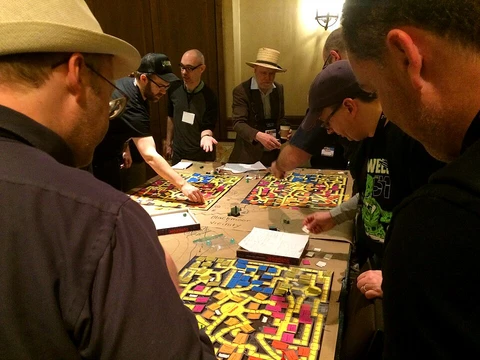
The board features three homebase hexes per player, plus nineteen outer hexes. The central hex always holds the monolith, an elevated cardboard structure that grants bonuses and gives the game a king-of-the-hill dynamic. A modular board and randomly placed exploration tiles create a randomized feel, though tile composition limits placement in certain ways.
Fantasy Flight Games reprinted Nexus Ops in January 2012. This edition includes a revised rulebook with many new optional rules and alternative ways to play.
- designer
- Charlie Catino
- publisher
- Avalon Hill
- release_year
- 2005
- reprint_publisher
- Fantasy Flight Games
- reprint_year
- 2012
- genre
- Science fiction strategy board game
- victory_condition
- 12 victory points (adjustable)
Lore & Background
Nexus Ops was designed by Charlie Catino and first released in 2005 by Avalon Hill. The game is set on a moon far off in space, where players mine the fictitious metal rubium. Rubium is used to recruit units, which include humans, fungoids, crystallines, rock striders, lava leapers, and rubium dragons. Each creature has a different attack value, and some possess special abilities. The goal is to reach 12 victory points, earned by winning battles and completing secret missions; the number of victory points can be changed to lengthen or shorten the game.
Reader's Guide
Nexus Ops is significant as a board game that combines resource management, unit recruitment, and tactical combat in a science fiction setting. Its modular board and exploration tiles introduce variability, while the monolith mechanic encourages central control, adding a king-of-the-hill dynamic. The game's adjustable victory point threshold allows players to customize game length. The 2012 reprint by Fantasy Flight Games extended the game's life by introducing optional rules, offering new ways to play. Though not a blockbuster, Nexus Ops has maintained a presence in the board gaming community, as evidenced by its listing on BoardGameGeek. Its design by Charlie Catino and publication by Avalon Hill place it within the lineage of mid-2000s strategy games that emphasize asymmetric unit abilities and territorial control. The game's legacy lies in its straightforward yet engaging mechanics, which have kept it relevant enough for a reprint and continued discussion among enthusiasts.
Did You Know?
- Nexus Ops was designed by Charlie Catino and released in 2005 by Avalon Hill.
- Players mine the fictitious metal 'rubium' to recruit units including fungoids, crystallines, rock striders, lava leapers, and rubium dragons.
- The center hex always contains the monolith, an elevated cardboard structure that gives bonuses and adds a king-of-the-hill flavor.
- Fantasy Flight Games released a reprint in January 2012 with a modified rule book containing many new optional rules.
Core Gameplay & Creature Roster
Nexus Ops, designed by Charlie Catino and first published by Avalon Hill in 2005, throws players into a science-fiction mining operation set on a distant moon. The central resource is rubium, a fictional metal that fuels every strategic decision. Players spend rubium to recruit an eclectic roster of combat units—humans, fungoids, crystallines, rock striders, lava leapers, and even rubium dragons. Each of these creatures carries its own attack value, and several possess special abilities that differentiate them in combat. Victory is measured in points, with the standard target set at twelve, earned through two channels: winning battles and completing secret missions. Importantly, the threshold is adjustable, letting groups dial in a shorter or longer session to suit their table. This blend of resource management, unit variety, and dual victory paths gives the game a layered strategic texture that rewards both aggressive and cautious play styles.
Board Architecture & the Monolith
The physical playing surface of Nexus Ops is built around a hex-grid layout that balances fixed structure with variable placement. Each player commands three homebase hexes, while nineteen additional hexes sit outside those territories, forming the contested middle ground. At the very center of the board sits the monolith, an elevated cardboard structure that stands apart from the flat hexes around it. Controlling this hex grants a player bonuses, and its central position gives the game a distinct king-of-the-hill dynamic, pulling action toward the middle. Beyond the fixed hexes, the board is modular: exploration tiles are placed at random, and while the composition of available tiles restricts how they can be arranged, the resulting layout still shifts from game to game. This combination of a stable core framework with randomized peripheral elements creates a familiar yet unpredictable terrain, ensuring that no two sessions unfold along identical strategic corridors.
Publication History & the Fantasy Flight Reprint
Charlie Catino designed Nexus Ops, and it first reached the market in 2005 under the Avalon Hill banner, a name long associated with classic wargaming and strategy titles. For several years the game lived in that original edition, and then in January 2012, Fantasy Flight Games stepped in to issue a reprint. This was not merely a reissue of the same box; the Fantasy Flight edition came with a modified rule book that introduced a substantial collection of new optional rules and alternative ways to play. For long-time owners of the 2005 version, the reprint represented an opportunity to revisit a familiar game with fresh strategic layers. For newcomers, it offered a more accessible entry point into Catino's design, packaged with the quality and distribution reach of a major modern publisher. The reprint effectively extended the game's shelf life well past its initial release window, keeping Nexus Ops in active rotation at gaming tables more than a decade after its debut.
Strategic Variety & the Randomized Experience
One of Nexus Ops' defining qualities is the tension it creates between planning and adaptability. The modular board, combined with randomly placed exploration tiles, means that the terrain each group faces is never quite the same, even though the tile composition imposes certain placement constraints. This randomized feel forces players to read the board fresh every session rather than relying on memorized routes. On top of that terrain variability, the creature roster adds another layer of decision-making: choosing whether to field a lava leaper for its special abilities or a crystalline for a different attack profile, for instance, changes the tactical calculus of every engagement. The dual victory track—battles and secret missions—further diversifies strategy, since a player who focuses exclusively on combat may fall behind one who quietly completes objectives. Together, these systems ensure that the path to twelve victory points can look radically different from one table to the next, even when the same group plays the same edition of the game.
Gallery

Frequently Asked Questions
What is Nexus Ops?
Nexus Ops is a 2005 science-fiction strategy board game in which players battle and mine on a far-off moon to harvest a fictional metal called rubium. It was designed by Charlie Catino and originally released by Avalon Hill.
Who designed Nexus Ops and who published it?
Charlie Catino created the game, and Avalon Hill put out the original 2005 edition. Fantasy Flight Games later issued a reprint in 2012.
How do you win a game of Nexus Ops?
A player wins by accumulating 12 victory points, which are earned through winning battles and completing secret missions. The target score can be adjusted to suit different group sizes or pacing preferences.
What units can you recruit in Nexus Ops?
Players can field six creature types—humans, fungoids, crystallines, rock striders, lava leapers, and rubium dragons—each with its own attack value, and some carry special abilities that set them apart in combat.
What role does rubium play in Nexus Ops?
Rubium is the fictional mineral players extract on the game's moon; it functions as the shared resource you spend to recruit and deploy your mining and combat forces.
More in Adventure board games 1-22
Spotted an error? Know more?
This is a living reference — every entry is fact-audited, and reader corrections feed straight into our audit queue. Suggest an edit · See this site's audit record