Nîn-Gonost
Modular magnetic dungeon board game with tactical combat.

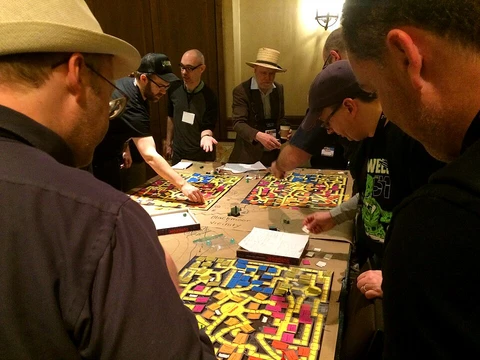
Nîn-Gonost: La Forteresse des Larmes is a fantasy adventure board game published by Fantasy Forges Games, a French game company. The game features a modular, magnetic game board and its name means 'Fortress of Tears' in the setting's antique elvish language. Designed by Alain Henner and Arnaud Borne, the game gained attention for its detailed combat system and was nominated for the As d'Or (Golden Ace) award at the Cannes Games Festival.
- Publisher
- Fantasy Forges Games (French)
- Designers
- Alain Henner, Arnaud Borne
- Game Type
- Fantasy adventure board game
- Notable Feature
- Modular magnetic game board
- Award Nomination
- As d'Or (Golden Ace) at the Cannes Games Festival
Lore & Background
Nîn-Gonost: La Forteresse des Larmes was published by Fantasy Forges Games, a French company. The game's name translates to 'Fortress of Tears' in the setting's antique elvish language. The designers are Alain Henner and Arnaud Borne. The game uses a modular magnetic dungeon board with tiles representing floor, wall, and obstacles that snap together, affecting line-of-sight, cover, and positioning in combat.
Gameplay is turn-based, with each player controlling miniatures up to an agreed total value (typically 150). Each miniature has a character card with statistics. Movement uses walk and run speeds, with run requiring a preceding walk action and a subsequent walk action to slow down. Melee combat uses Duel Dice and a Fate Die, with outcomes including instant kill, perfect block, mutual death, or damage resolution based on the difference in dice scores plus the winner's damage versus the loser's resistance. Ranged combat uses an Accuracy Die and Fate Die, with similar outcomes and a critical failure breaking the bowstring.
Advanced rules add statistics such as manna, strength, con, dexterity, per, wil, ctr, wtg, and specific armor and weapon stats. After the initial boxed set, the original designers Alain Henner and Arnaud Borne released 'Nîn-Gonost: Adiken', which introduced CounterStrike and many rule enhancements. The revised rules streamlined play and were nominated for the As d'Or at the Cannes Games Festival, though the company did not last long enough to release planned expansions.
Reader's Guide
Nîn-Gonost is significant as a fantasy board game that introduced a modular magnetic game board, allowing dynamic dungeon layouts that directly influenced tactical combat. Its combat system, with Duel Dice and Fate Die mechanics, offered a blend of randomness and strategic modifiers, including flanking and cover. The game's nomination for an Origins award (though the category is disputed between 'best miniatures game' and 'best miniatures rules') indicates its impact within the hobby gaming community. The revised Core Rules by Paul DeStefano corrected translation and playtesting errors, streamlining gameplay and enhancing the magic system, which improved the game's reception. However, the company's inability to release planned expansions limited its long-term legacy. The game remains notable for its detailed character statistics and the unique requirement that engaged characters must continue fighting unless they disengage by stepping back at a cost of action points. Its legacy is preserved through the official game website and BoardGameGeek entry.
Did You Know?
- The game's name means 'Fortress of Tears' in the setting's antique elvish language.
- In the basic rules, there are no hit points; a character dies if damage exceeds resistance.
- A character can run only after spending an action point walking, and must spend another action point walking to slow down.
- The revised rules in 'Nîn-Gonost: Adiken' by Alain Henner and Arnaud Borne introduced CounterStrike as a possible combat outcome.
Frequently Asked Questions
What is Nîn-Gonost?
Nîn-Gonost, subtitled "La Forteresse des Larmes," is a fantasy adventure board game published by the French studio Fantasy Forges Games. It centers on tactical combat set within a dungeon environment.
What does the name Nîn-Gonost translate to?
In the game's antique elvish language, the title means "Fortress of Tears." This translation reflects the setting's lore and the game's atmospheric theme.
Who are the designers behind Nîn-Gonost?
The game was created by Alain Henner and Arnaud Borne. Both worked with Fantasy Forges Games to develop the title's combat system and board mechanics.
What is special about Nîn-Gonost's game board?
The board is built from modular pieces that connect magnetically, allowing players to rearrange the dungeon layout between sessions. This design gives the game a high degree of replayability.
Has Nîn-Gonost received any award recognition?
Yes—the title earned a nomination for the As d'Or (Golden Ace) prize at the Cannes Games Festival. The nomination specifically highlighted the game's detailed combat system.
More in Adventure board games 1-22
Spotted an error? Know more?
This is a living reference — every entry is fact-audited, and reader corrections feed straight into our audit queue. Suggest an edit · See this site's audit record